Tuesday, July 13, 2010

Top 50 Games - 18. Metal Gear Solid 3: Subsistence


Just to get this out of the way quickly: I was wondering whether to pick Snake Eater or Subsistence, since I originally played the former, but I ultimately opted for Subsistence since its much-improved camera greatly enhances the original game, not to mention its bevy of extra content. Now, about Metal Gear Solid 3. What we have here is considered by quite a few folks to be Kojima's greatest creation; the perfect synthesis of newfangled cinematic ambition and good-old-fashioned game design, the one Metal Gear entry that truly fulfills the promise of the original concept. A few fans were also slightly disappointed upon the game's 2004 release, myself somehow among them. While MGS3 is certainly not my favorite Metal Gear, I love it much more now than I did back when I first played it. It is one of those rare games that seems to get better the more I play it and think about it. Chronologically a prequel to every other game in the series, MGS3 takes place during the hottest era of the Cold War, in 1964. It also abandons the cold grays and blues of past Metal Gear bases with the wild and verdant Russian jungle. The setting is refreshing and Kojima takes advantage of it: codac conversations with your support team's medic reference movies like Godzilla, and the forest environment is rife with immersive detail, much of it able to be interacted with by Snake (who in this installment is actually a young Big Boss). Snake can climb trees and hang from branches while shooting a sidearm, trip enemy booby traps that are hidden in the vegetation, and hunt wild animals to replenish his stamina. The camouflage and stamina systems add a nice survival element to the gameplay, and the environs (coupled with the lack of a radar) make stealth tactics even more nuanced and necessary. The vintage 60's gadgetry is great, too, from sonar to the fake death pill. With its complex control scheme, improved AI, unpredictable environment, and amusing technologies, MGS3 is the most enjoyable tactical espionage action sandbox in the series. Nearly every location in the game can play host to ridiculously cool scenarios due to the game's stunning sophistication. Press and hold square near a guard to get him in a chokehold. From here you can knock him unconscious by tapping square repeatedly, throw him to the ground violently by pressing square and moving the left analogue stick, or cut his throat by pressing down hard on the same button. You can throw grenades into the mouths of alligators, shoot a beehive down onto the head of an unsuspecting sentry, and poison enemies with rotten meat. Snake likes some food more than others and lets you know, there's a built-in system for manually curing his wounds (in here you can burn leeches off with your cigar), if you let the game over screen run too long, the words SNAKE IS DEAD will become TIME PARADOX. The level of authored and emergent detail on display here is lightyears beyond what other developers even attempt to offer. It truly boggles the mind, and it is present at every point in the game. Nowhere, though, is the craftsmanship and creativity of Kojima and his team more apparent than in Metal Gear Solid 3's now-legendary boss fights. You know how I mentioned poisoning enemies with rotten food? Every boss has a stamina bar like yours, and one them, The Fear, needs to scour around for sustenance mid-battle to restore it. That's right: throw some decomposing rabbit on the ground, and he'll scarf it up, only to realize that his voracity doomed him to a humiliating death. Many people make a big deal about the game's final boss (aptly named The Boss), and for good reason. The fight is beautiful, taking place in a field of white lilies, and it calls on every skill you've learned to take down the woman who taught them to you. As good as that climactic duel is, the best boss fight in the game, and my favorite of all time, is Snake's encounter with a very old sniper called The End. The battle plays out in three large jungle areas full of interesting terrain and tactical points of interest. The End is well-camouflaged and often perched high on some grassy cliff, making it difficult to see him. He sees you, though, and although he is only using tranquilizer rounds (which lower your stamina and drain light from the screen), you feel hunted in a way you've likely never felt before. To best him you need to make use of every gadget and tactic available to you. You can use the directional microphone to zero in on his heavy breathing and the map to determine his last known position. You can sneak up on him, he can sneak up on you, you can kill his beloved parrot (his painfully enraged reaction is terrifying), he can regain life energy from beams of sunlight, and you can let him die of old age by turning your system's clock forward seven days. It is the perfect video game battle, sprawling and epic, deeply immersive, and suffused with memorable details, be they humorous or horrifying. As for the story, I'll call it the least stupid in the series (don't get me wrong, I love these tales) and not go into more detail than that. A humorous and surreal covert affair that's packed full of creative details, ingenious flourishes, and memorable moments, Metal Gear Solid 3 is easily one of the most treasured games in my collection.

Top 50 Games - 19. The Legend of Zelda: Ocarina of Time


Is Ocarina of Time the greatest game ever made? Well, according to me it's not, seeing as how I awarded Super Mario Bros. that title quite a few posts ago (it was #48). Is Ocarina of Time in the top 5, at least? Absolutely. Okay, but why isn't it in my own personal top 5? This one is pretty easy to explain (although some may not consider my excuse good enough): I never owned a Nintendo 64. The Legend of Zelda: Ocarina of Time was not my first Zelda game, and by the time I played it, the years had cruelly stolen a little bit of its original luster. This masterpiece, easily one of Nintendo's greatest accomplishments, is still pretty damn high on my list though; there are only 18 games that I love more. While the graphics may no longer present the most stunning virtual landscape ever created, and the control has since been polished, there are quite a few areas of this game that remain nearly untouched. The brilliance of its innovative features, the divine quality of its music, and the genius of its overall design have barely been surpassed since its release in 1998 (in my humble opinion, the greatest year for video games ever). Ocarina of Time was born during a strange but fertile time: faced with the challenge of bringing Hyrule into the third dimension, the peerless talents at Nintendo invented by necessity aspects of 3D gaming that we have all taken for granted. One of 3D's most troublesome new problems was the camera; Super Mario 64 did its best to tame the ugly beast, but OoT's solution was much more elegant. The only way to adjust the view was to press the Z-trigger and re-center it behind Link. Pressing the Z-trigger near an enemy or character would letterbox the screen and focus Link's movements and actions around the targeted object. Z-targeting, as it would be called for years afterward, was an ingenious blessing. It helped make interaction in a 3D world much more enjoyable, and was the foundation for a combat system that still holds up to this day (which is not something that many games of the early 3D era can claim). Also new to 3D gaming was an open world ready to be explored without restrictive load screens or self-contained levels. Gamers were equipped with all the tools necessary to conquer this faraway world, using trusty steed Epona to gallop across the expansive Hyrule Field, series staples such as arrows, boomerangs, and bombs to fell Ganon's minions, and new additions like the Iron Boots and Bombchus to explore more of the fascinating kingdom. There was a day-night cycle (skeletal Stalfos enemies were much more common at night), a variety of entertaining minigames like fishing in Lake Hylia, and more details that served to keep gamers enraptured for long stretches of time. One of the game's most impressive features is its mind-bending time travel mechanic. Focused on the two most important items, the titular Ocarina of Time and the classic Master Sword, at the Temple of Time Link is able to choose between two realities: one in which he is a child, and one that finds him a fully grown young adult. This duality creates many new puzzles, some of which are more devious and clever than any in the series. Magic beans can be purchased and planted in certain areas by a young Link; when revisiting the area as an adult, plants will have grown, allowing you to reach previously inaccessible areas. Certain items can only be used by each version of Link as well, further complicating an already sophisticated game. Some consider the dungeons to be at the heart of the Zelda experience, and while I wouldn't agree wholeheartedly with that sentiment, I will say that Ocarina of Time boasts many of them, not a single one of which is poorly designed (even the Water Temple). They are more often than not dark, musty, murky, and thoroughly tricky puzzle-boxes loaded with dangerous enemies, thoughtful challenges, and awesome boss fights. They can get pretty creative too, with one taking place inside the belly of a giant fish. Maybe the best applications of the gameplay mechanics can be found in the dungeons, but OoT's soul can easily be discovered in any of the game's rapturous melodies. Koji Kondo is without a doubt the greatest composer in the industry, and his work on display here is positively brimming with emotion and warmth. Many a gamer who has spent time in Hyrule knows that he will never ever get Saria's Song and Zelda's Lullaby out of his head. I consider the latter to be one of the greatest melodies ever written, bar none, and it, along with the title screen music, is enough to reduce any vulnerable video game lifer to goo. The most important, most timeless, most affecting 3D game ever released, The Legend of Zelda: Ocarina of Time deserves all the praise that can be thrown at it.

Top 50 Games - 20. Call of Duty 4: Modern Warfare


I dislike Activision. I dislike Xbox Live. I dislike Call of Duty: Modern Warfare 2. I dislike war. But I like Call of Duty 4. A lot. Why is that? Before this blockbuster entry in the part arcadey, part realistic FPS series, WWII was the setting for the shell-shocked player's exploits. After Call of Duty 2, which in my opinion perfected that vein of shooter, Infinity Ward set its iron-sights on the very near future. Sure, the story is pretty stupid, what with Islamic fundamentalists and Russian neo-Stalinists banding together to destroy the US of A, but it provided context for a visceral first-person experience that was more intense, unsettling, and surprising than World War II could ever be (in a video game, I mean). When you're in the thick of it, with AK fire spraying every concrete wall, grenades landing right at the tips of your toes, and helicopters spiraling out of control after being downed by an RPG, it's hard to imagine any gamer wanting things to get even more realistic. While COD4 of course takes many liberties with reality, the immersive experience seems about as true to the blinding, deafening, dumbing chaos of war as I'd ever want video games to get. Yes, Call of Duty squeezes a great deal of fun out of something as evil and atrocious as war, but (although its developers hardly weaved any subtlety or ambiguity into their creation), one could claim that it asks questions about entertainment, reality versus fantasy, or the hypocritical wiring of the human brain. Of course, when you're (fictionally) defending your position with a barrage of MG fire, carrying a pilot out of her crashed bird while being flanked by the enemy in large numbers, or chasing the son of a Russian madman through a dilapidated warzone, you don't really have time to think about those kinds of things. The bullets left in your clip, the locations of your squadmates, the fierce tactics of your enemies: that's what's on your mind. Doubly so in the competitive multiplayer mode, where, without the scripted predictability of single-player, your enemy can be anywhere, and even worse: he's not AI, but rather a human. Intensity and excitement are wholly embraced by COD4's audiovisual and tactile synthesis, and are most pronounced during the most spontaneous moments of multiplayer and most scripted and dramatic of the campaign. Such moments include the player-character being killed by a nuclear blast, but not before witnessing its horrid destructive power, and (in the game's best level), sneaking through an irradiated wasteland in a ghillie suit before attempting to assassinate previously mentioned Russian madman with a .50 cal while adjusting for the Coriolis effect. A powerful showcase for next-generation technology and developer craftsmanship, Call of Duty 4: Modern Warfare is an intoxicating jolt that I'm happy to receive solely through artificial means.

Top 50 Games - 21. Final Fantasy X


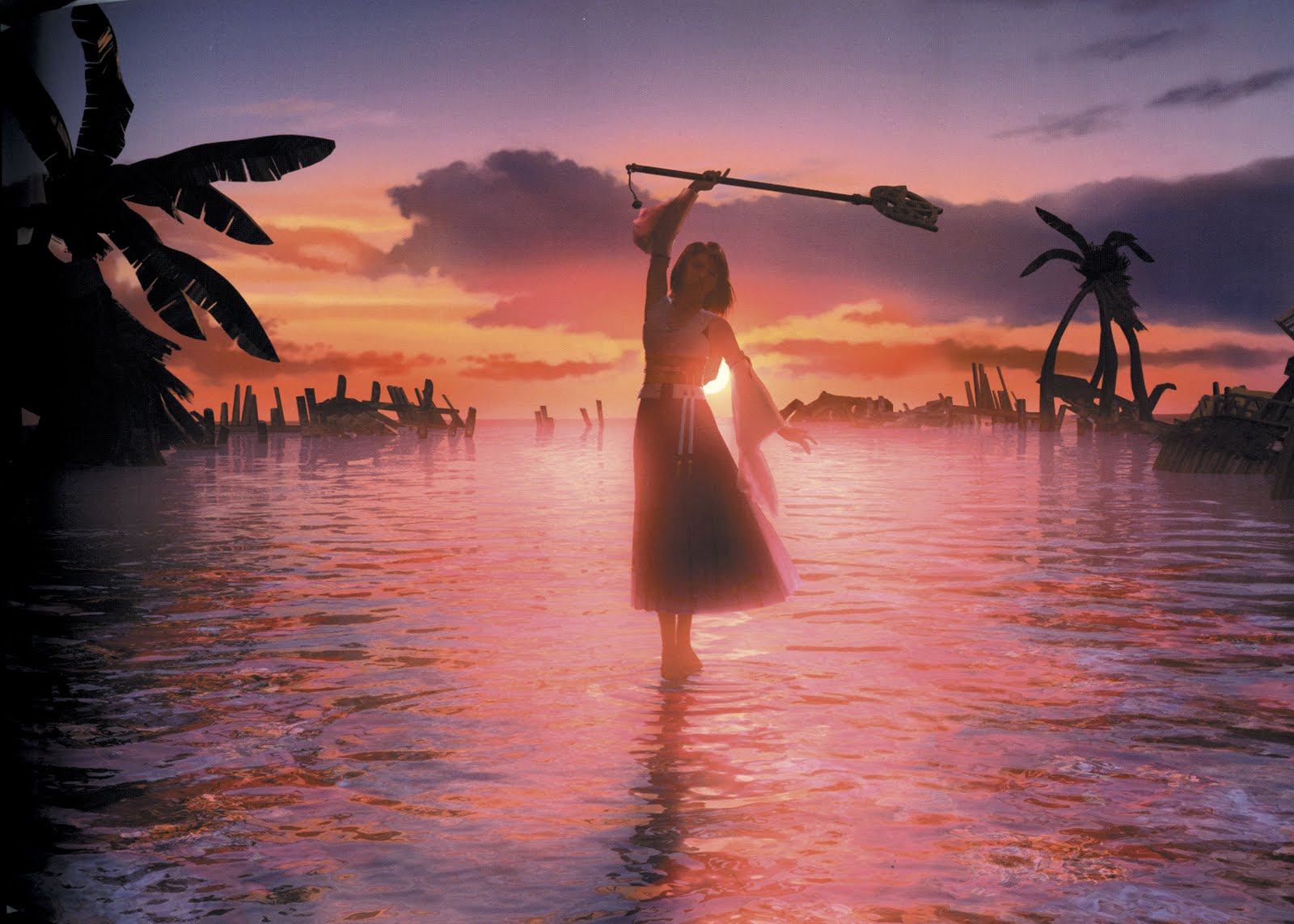
Yes, Tidus is annoying and that fake laughing scene with him and Yuna is a bit painful. Now that we've gotten that out of the way, let's talk about Final Fantasy X. The first game in the long-running JRPG series to arrive on the Playstation 2, FFX set a new graphical standard upon arrival. It was also the first Final Fantasy with fully voiced main characters. Final Fantasy has many times proven to be about the characters as much as anything else, and the added (though, as mentioned, occasionally subtracted) believability that voice acting and graphical fidelity provided really brought the cast to life in a way that hadn't been done before. The best example I can think of is Wakka, whose vocal charms would have gone unappreciated if we weren't able to hear his distinctive tropical accent. Final Fantasy X may actually be one of the most character-focused games in the series, as they contribute heavily not only to the story, but also to the fundamentals of gameplay. FFX's battle system abandoned ATB (active time battle) for a straightforward turn-based style. In ATB's place however, were new innovations. A list in the upper-right corner of the screen clued players in to the order of turns between their party members and the enemies. The second innovation, and one that Square should be ashamed of for not including sooner, is the ability to switch party members in and out of the battle's three-person lineup at any time, without forfeiting the turn. This may seem convenient, and it is, but it also adds a new layer of strategy to the deliberately paced fights. For the first time in ages, the party in a Final Fantasy game is comprised of distinguished individuals, each one of them wholly necessary for participation in combat. While the "level up" system, the Sphere Grid, can be "broken" by moving a character into another's field, for the most part each party member possesses unique abilities that come into play quite often. Tidus has speed, Yuna has white magic, Auron has brute force, Kimahri learns enemy abilities, Wakka has a ranged attack, Lulu has black magic, and Rikku can steal. While the random battles can be painful, the bosses are epic, slow-paced, cinematic affairs that test the strategic skills of the player. Outside of battle is a beautiful world full of small tropical islands, long dirt roads, and wide open plains. Unfortunately, this world called Spira was the most linear of the series until FFXIII came along. It's easy to ignore however, because you're constantly wrapped up in a story that is paced calmly but always moving forward. This story is one of the most well-crafted and emotional in a series known for epic tales that are just that, and riding along with it to its dramatic conclusion is a sweeping, magical experience matched in power by only a few other video games.

Sunday, July 11, 2010

Top 50 Games - 22. Grand Theft Auto: San Andreas


I don't much care for running over pedestrians and blowing up police helicopters in San Andreas. I'm much more content to hop on a bicycle, improve my cycling skill by pedaling around for a while, and then precede to bunny hop over some taxis. Or maybe I'd like to play an early 90's arcade game in which you control a bumblebee. Or activate the flying cars cheat, spawn a garbage truck, and cruise around the smoggy orange skies of Los Santos (LA) while listening to some Hank Williams. Or ride a jetpack. Or play pool. Or eat so much pizza that I hurl it back up in a charmingly low-res green mist. Or take pictures. Or go skydiving. There's more, but I think you get the idea. What used to be a game that almost exclusively concerned itself with highly criminal activity like murdering prostitutes became so much more. San Andreas, to employ the comically abused term, is a big ol' sandbox. It engages the same part of the brain that is tickled when a child plays with his toys, but instead of imagining it yourself, Rockstar does it for you. San Andreas, with its three cities and connecting countryside, could be accused of "quantity not quality" if it weren't so damn fun nearly all the time. Sure, the story missions can be frustrating as all hell, but (although they are varied and contain some great acting and writing) who plays the story missions? No, the "point" of San Andreas is to fuck around and enjoy all the wonderful chaos that ensues from your lazy thumb-tapping inputs. In the PS2 era, no other game could claim the level of variety, immensity, and insanity that Grand Theft Auto: San Andreas possessed. It had a killer soundtrack, an interesting setting, awesome cheat codes, a hilarious and huge script, an enormous play area, and you could even turn protagonist CJ into a fat slob like yourself. Good stuff.